If you’ve ever walked through a busy warehouse, a small manufacturing shop, or a retail storage area, chances are you’ve spotted a manual stacker gliding through aisles to move pallets, load boxes, or restock inventory. For small to medium businesses, these tools are workhorses—affordable, easy to operate, and far more maneuverable than bulky forklifts. But over the years, one question has come up again and again in our inbox and during in-person client meetings: Can manual stackers be used on uneven floors? Manual Stackers
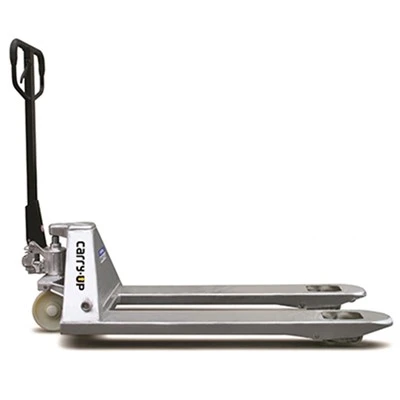
As a manual stacker supplier, I don’t just answer this question with a quick yes or no. I’ve seen firsthand how uneven floors—whether in an old warehouse with cracked concrete, a loading dock with uneven ramps, a basement storage area with sloped surfaces, or a construction site’s temporary workspace—can turn a routine task into a safety hazard. The answer isn’t black and white. It depends on the type of manual stacker, the severity of the floor unevenness, and how you operate the equipment.
Let’s break this down, starting with what a manual stacker is, because not all units are built the same. A standard manual stacker is a hand-powered tool that uses a hydraulic system to lift pallets or loads to heights between 60 inches and 120 inches, far enough to place items on high shelves or stack them neatly. Most basic models are designed for flat, smooth surfaces—think newly installed warehouse concrete or level loading docks. But over the past five years, we’ve developed several lines of manual stackers specifically engineered to handle uneven terrain, and that’s where the confusion starts.
First, let’s talk about what “uneven floors” actually mean. I define this as any floor with deviations greater than ½ inch over a 10-foot span. That could be a small dip in a concrete slab, a raised expansion joint, a sloped surface with a 1% to 5% incline, or even outdoor areas with loose gravel or uneven pavement. For a basic manual stacker with standard fixed wheels, operating on a floor with even a ¼-inch deviation can cause instability. The two front wheels of a basic manual stacker are rigidly attached to the frame, so if one wheel hits a small bump, the frame tilts, shifting the load’s center of gravity. That’s a major safety risk—pallets can tip, the stacker can tip over, and operators can get hurt. We’ve had clients who learned this the hard way: one small business in Ohio tried to use a basic manual stacker in their old warehouse with cracked concrete, and a 500-pound pallet of supplies tipped, damaging inventory and injuring their part-time operator.
But not all manual stackers are basic. Our heavy-duty models, which feature pivoting front wheels, are designed to distribute weight evenly even on uneven floors. Pivoting front wheels, also called “steerable casters,” swivel independently, so each wheel stays in contact with the ground as the frame moves over bumps or slopes. This small design change makes a huge difference. I’ve watched our own team test these stackers on a test track with ¾-inch bumps and a 3% incline; the stacker glides smoothly, no tilting, no swaying, even with a 1,500-pound load. That’s a key point to remember: if your floor has minor to moderate unevenness (deviations up to ¾ inch, inclines up to 5%), a pivoting wheel manual stacker is safe to use.
Now, what about more extreme unevenness? If you’re dealing with surfaces with deviations over 1 inch, steep inclines (over 5%), or loose surfaces like dirt or gravel, manual stackers—even the heavy-duty ones—aren’t the best choice. I’ve seen some clients try to force it, but that leads to excessive wear and tear on the stacker, increased risk of damage to goods, and higher chances of operator injury. For those cases, a forklift or a rough-terrain stacker with motorized traction is a better fit. But for 90% of the small to medium businesses we work with, which operate in older warehouses, retail backrooms, or manufacturing spaces with mild to moderate uneven floors, a good quality manual stacker with pivoting wheels works perfectly.
Another factor that often gets overlooked is operator training. Even the best manual stacker won’t perform safely if the operator doesn’t know how to navigate uneven floors. I always tell clients: slow down. On flat surfaces, it’s easy to move at a brisk pace, but on uneven terrain, take it 50% slower than you normally would. Avoid sudden stops or turns, because that can shift the load. When you’re approaching a bump or a joint, center the stacker over the obstacle before moving forward. If you’re on a slight slope, position the load’s heaviest side facing uphill—this keeps the center of gravity low, which prevents tipping. We offer free one-hour training sessions for all our clients, and every time we do, we emphasize these tips because they make a bigger difference than the stacker itself.
We also get questions about maintenance. If you’re using a manual stacker on uneven floors, how do you keep it in good shape? The rigid frames and fixed wheels of basic stackers take a lot of stress on uneven surfaces, leading to bent wheel axles or worn hydraulic seals. Our pivoting wheel models are built with reinforced frames, so they handle the stress better, but regular inspections are still important. I recommend checking the wheels every two weeks for wear, tightening any loose bolts on the frame, and testing the hydraulic system to make sure it’s working smoothly. If you notice any wobbling or tilting when moving, stop using the stacker until you have it checked by a technician. For many clients, we offer annual maintenance plans to keep their equipment running safely, which saves them money in the long run by avoiding expensive repairs or replacements.
Let’s also talk about real-world examples. A customer of ours in Florida runs a chain of grocery stores with 12 locations. Their older stores have backrooms with uneven concrete, some with ½-inch expansion joints and slight slopes. They used to rent forklifts for moving pallets in those backrooms, but forklifts are too big for the narrow aisles. After we supplied them with 18 pivoting wheel manual stackers, they told us their pallet moving time dropped by 30%, and they had zero safety incidents in the past two years. They even told us that their operators prefer the manual stackers because they’re easier to maneuver on uneven floors than the old basic models they used to use. Another customer, a small construction company in Texas, uses manual stackers on their temporary job sites to move building materials between trucks and storage areas. Their site has uneven dirt and gravel, so they use our heavy-duty rough-terrain manual stackers with pneumatic tires instead of solid rubber. The pneumatic tires absorb small bumps, making the ride smoother, and they can handle the loose ground without sinking. That’s another key design choice: tire type. Solid rubber tires are good for smooth concrete, but pneumatic tires are better for uneven, softer surfaces.
I know there’s a lot of misinformation out there about manual stackers and uneven floors. Some online forums say you should never use a manual stacker on anything other than perfect concrete. But that’s not true—at least not for the right model. The key is matching the stacker to your floor conditions. If you’re not sure what your floor’s unevenness is, you can test it with a straight edge and a ruler. Lay the straight edge on the floor, and measure the gap between the straight edge and the floor at the biggest point. If that gap is less than ¾ inch, a pivoting wheel manual stacker will work. If it’s more than ¾ inch, or your floor has inclines over 5%, you’ll need a different piece of equipment.
We’ve also heard from clients who were worried about damaging their warehouse floors by using manual stackers. That’s a valid concern—basic manual stackers with solid rubber tires can leave scuff marks on concrete, especially if you’re turning quickly. Our pivoting wheel models have treaded tires that distribute weight more evenly, so they cause less scuffing, which is a big plus for businesses that want to keep their floors looking good. For businesses with very uneven floors, we even offer custom wheel sets that are slightly wider, which further reduces pressure on the floor and makes the stacker more stable.
At the end of the day, manual stackers are designed to make lifting and moving loads easier, not to create more work or risk. They’re not meant for extreme terrain, but for most commercial and industrial spaces, they can absolutely be used on uneven floors as long as you choose the right model and follow basic safety guidelines. As a supplier, our goal isn’t just to sell equipment—it’s to help our customers find the right solution for their specific needs. If you’re not sure which manual stacker is right for your uneven floors, or if you have questions about safety or maintenance, we’re here to help. Whether you’re a small business owner looking to upgrade your equipment, a warehouse manager trying to reduce safety incidents, or a construction supervisor needing a reliable tool for job sites, we can work with you to find the perfect manual stacker that fits your space, your load requirements, and your budget.
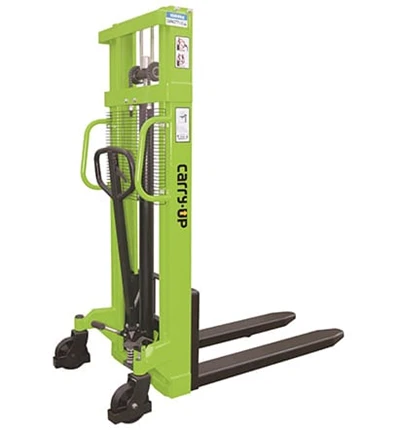
Don’t let uneven floors hold you back from getting the most out of your manual stackers. With the right equipment and a little bit of training, you can move loads safely and efficiently, even in less-than-perfect spaces. If you’d like to learn more about our manual stackers for uneven floors, or to discuss your specific needs and get a customized quote, reach out to our team to connect for a procurement conversation. We’re ready to help you find the solution that works for your business.
Hand Pallet Trucks References
- Occupational Safety and Health Administration (OSHA). (2020). Powered Industrial Trucks: Safety Requirements. U.S. Department of Labor.
- Material Handling Industry (MHI). (2022). Manual Lift Equipment Performance Standards. MHI Global.
- National Institute for Occupational Safety and Health (NIOSH). (2021). Manual Material Handling Safety for Small Businesses. Centers for Disease Control and Prevention.
- Warehouse Education and Research Council (WERC). (2023). Uneven Floor Handling Best Practices for Industrial Equipment. WERC International.
Hangzhou Carry Equipment Co., Ltd.
Hangzhou Carry Equipment Co., Ltd. is one of the most professional manual stackers manufacturers and suppliers in China, also supports customized service. Please feel free to buy advanced manual stackers for sale here and get quotation from our factory. For price consultation, contact us.
Address: No.360 Tongxiang Rd., Yinzhou Economic Development Zone, Yinzhou Dist., Ningbo, China
E-mail: Sales@carryupmhe.com
WebSite: https://www.carrymhe.com/
