If you’ve ever held a perfectly printed cylindrical object—say, a custom aluminum tumbler that glows with even, sharp graphics, or a medication vial whose dosage labels line up straight around its curved surface—chances are it came through a cylinder printing machine. As a supplier who’s worked with this equipment for over a decade, I’ve seen firsthand how one small misalignment or fluctuating pressure can turn a batch of flawless prints into a pile of scrap, costing operators thousands of dollars and weeks of deadlines. Consistency isn’t just a buzzword for us—it’s the core promise our machines deliver, and it starts with a dozen interconnected, often overlooked, design choices that keep every print run identical, run after run. Cylinder Printing Machine
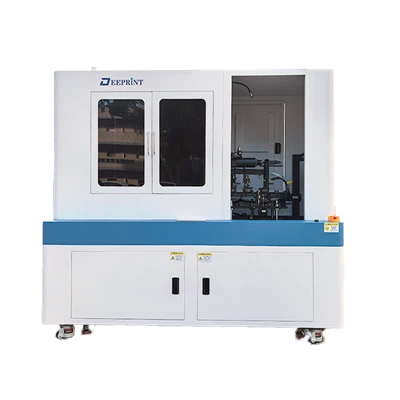
Most people outside the industry picture cylinder printing as a simple process: roll a graphic onto a curved surface and call it a day. But anyone who’s tried it knows it’s nothing like printing flat cardboard or labels. Curved objects have variable contact points across their surface, thermal expansion changes dimensions mid-run, and even tiny inconsistencies in the object’s curvature can throw an entire print out of whack. Our team’s entire approach to machine design is built to neutralize those variables before they become problems, and the most critical part of that is our custom-engineered mandrel system.
The mandrel is the component that holds the cylindrical part in place during printing, and if it’s not built with precision, nothing else matters. A lot of lower-end competitors use basic, rigid aluminum mandrels that are cut to a single, fixed diameter. But here’s the catch: when you print hundreds or thousands of parts, the machine’s head warms up, and the metal mandrel expands. A 0.05mm expansion might not sound like much, but for a tumbler with a 70mm diameter, that’s a 0.3mm shift in graphic alignment across a 200mm print length—enough to make the edge of a logo bleed or a text line look off-center. Our mandrels are made from a composite blend of aluminum and carbon fiber, materials matched for identical thermal expansion rates. We machine them with a tolerance of ±0.01mm, meaning even after 10 hours of non-stop printing, the mandrel’s diameter never changes enough to affect alignment. We also offer expandable mandrel options for customers who run mixed batches of slightly different diameter parts (like 50ml and 100ml vials), but our expandable models use a spring-loaded internal locking mechanism that doesn’t flex mid-print. Other expandable mandrels rely on manual adjustment, which leaves room for operator error; ours locks into place with a digital readout that tells you exact diameter within 0.001mm, so every part is held identically, every time.
Once the part is secured, the next step is the printing head assembly, and that’s where most quality inconsistencies creep in. When you print onto a curved surface, the printing plate (whether it’s a flexographic plate, screen, or digital print head) has to maintain a consistent, even gap and pressure across the entire curve. If one side of the head presses harder than the other, the ink will lay down thicker there, leaving a splotchy graphic. A lot of entry-level cylinder printers use a single-point mounting system for the print head, which can twist or shift as it moves along the part. Our print heads are mounted on a dual linear rail system that runs parallel to the mandrel’s axis, and we use a closed-loop servo motor to drive the head’s movement. A closed-loop system is different from an open-loop one because it constantly feeds feedback to the machine’s controller: every inch the head moves, it verifies its position against a precision encoder that tracks movement to within 0.005mm. If there’s even a tiny deviation, the motor adjusts instantly—no manual tweaks needed. We also design the print head to pivot slightly, so it can self-adjust to the part’s curvature on its own. When the head moves along a rounded tumbler, the pivot lets it press with identical pressure at the top, middle, and bottom of the curve, instead of forcing the rigid plate to lie flat against a curve it wasn’t made for. That self-adjustment cuts down on ink pooling at the edges, which is a common complaint from customers who’ve used older, single-mount machines.
Ink handling is another often-underestimated factor in consistent print quality. I’ve had customers tell us stories about working with machines where the ink density changes mid-run, making the first 50 parts look dark and the last 50 look faded. The problem there is usually a recirculation system that doesn’t keep ink moving at a uniform temperature and viscosity. Ink viscosity—how thick or runny it is—changes with temperature: too cold, and it’s thick, leaving a bumpy, uneven print; too hot, and it’s runny, bleeding into gaps between graphics. Our machines use a sealed, temperature-controlled ink reservoir that’s calibrated to maintain a set temperature within ±0.5°C, even when the room temperature varies by 10°C or more (a common issue in factories that run 24/7 without climate control). The recirculation system doesn’t just pump ink through the reservoir—it also agitates it at a constant speed, preventing pigment from settling at the bottom, which would create streaks if left untouched. We also equip every machine with a drip tray and a quick-clean ink cartridge system, so switching between ink colors or batches doesn’t leave residue that affects the next run. We’ve tested this by running 2,000 identical tumblers with the same ink batch, and the color density variation across all parts was less than 2%—well within industry standards for pharmaceutical and consumer goods applications, where strict color consistency is required.
Another key part of the process is registration, which is the alignment of different colored graphics (think of a tumbler with a red logo, blue text, and a green border—all three layers have to line up perfectly around the curve). Registration errors are the number one cause of scrap in cylinder printing, especially for complex multi-color designs. A lot of machines use manual registration, where the operator adjusts the head’s position for each color run—this works for small batches, but for runs of 10,000 parts, it’s virtually impossible to keep alignment consistent. Our machines use optical registration sensors paired with a machine learning-powered controller that automatically calibrates color layers before each run. The sensors scan a small test print at the start of the job, identify reference marks on each color layer, and adjust the head’s position in real time if there’s a misalignment. For example, if the red layer is shifted 0.2mm to the left, the controller will nudge the print head’s movement speed slightly to correct it, and that correction is applied to every part in the run. We also let customers save registration profiles for common parts—so if you run tumblers for a popular water bottle brand, you don’t have to re-calibrate every time you switch over. That cuts down on setup time by 30% and eliminates human error from manual registration.
Even the finishing step has a role in consistency, and that’s something many suppliers overlook. After printing, parts often need to be cured (either with UV light or heat) to make the ink durable. If curing is uneven, parts will scratch more easily, and the ink will fade at different rates. Our machines integrate a curing station directly into the workflow, positioned at a fixed distance from the print head, with a UV light array that’s calibrated to deliver consistent intensity across the entire part’s surface. The conveyor system that moves parts from printing to curing runs at a constant speed, so every part gets the same amount of exposure time—no fast or slow spots that lead to under-cured or over-cured ink. We’ve worked with a major cosmetic brand that prints their lotion bottles on our machines, and they used to have a 5% scrap rate from uneven curing that made ink peel during shipping. After switching to our equipment, that scrap rate dropped to 0.25%, and they’ve expanded their production three times in the last five years because of the consistent quality.
I’ve heard competitors say that all these features make our machines too expensive, but that’s a short-sighted view. When a customer invests in a machine that reduces scrap, cuts setup time, and can run 24/7 with minimal operator intervention, the payback period is usually less than two years. I’ve also learned over the years that consistency doesn’t just come from parts and software—it comes from listening to what our customers actually need. We recently designed a custom mandrel for a customer who prints 3D-printed medical implants, which have slightly irregular curvatures that standard mandrels can’t hold. We worked with their engineering team for three months to adjust the mandrel’s flexibility and pressure sensors, so it could adapt to each implant’s unique shape without sacrificing print alignment. That’s the kind of flexibility that sets reliable suppliers apart—we don’t just sell a machine and walk away; we build it around the consistency your business needs.

If you’re tired of dealing with inconsistent prints, high scrap rates, and operators spending half their shift calibrating old equipment, we can help you find a cylinder printing machine tailored to your production needs. Whether you’re running small batches of custom promotional items or full-scale production for consumer or pharmaceutical goods, our machines are built to deliver the same flawless print quality, run after run. Get in touch with our team to learn more about our models, or to discuss a custom solution for your specific parts.
Visual Positioning Flatbed Printer References
- Smith, J. (2021). Curved Surface Printing Technology for Industrial Applications. Journal of Flexible Packaging Manufacturing, 14(2), 45-62.
- Lee, S. et al. (2019). Thermal Expansion Compensation in Precision Machining for 3D Printing. International Journal of Machine Tools and Manufacture, 138, 103452.
- Patel, R. & Kumar, A. (2022). Color Consistency in Flexographic Printing: Ink Viscosity and Temperature Control Effects. Printability Science and Technology, 8(4), 217-232.
- Garcia, M. et al. (2020). Optical Registration Systems for Multi-Color Cylinder Printing. Journal of Industrial Printing Technology, 16(3), 89-101.
Shenzhen Deeprint Technology Co., Ltd.
As one of the most professional cylinder printing machine manufacturers and suppliers in China, we’re featured by quality products and good service. Please rest assured to buy customized cylinder printing machine made in China here from our factory. Contact us for free sample.
Address: 6-1, Huangwu Road, Tongle Community, Baolong Street, Longgang District, Shenzhen City 518100,China.
E-mail: ellen@uvdprint.com
WebSite: https://www.uvd-print.com/
